R600?

Jon K.

Well-Known Member
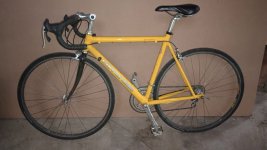
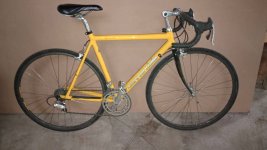
Let me just be honest, I know nothing about road bikes, just started riding my new (cheap) gravel bike. You stated that it has pricey Campy parts? Which parts? Also, I'm 6' tall, is this bike too small for me? Would I be better off selling this bike and find another bike for myself? The reason I like this bike is because it's so light.

From the codes on the bottom bracket shell and the lack of space between top tube and down tube at the head tube junction, I'm guessing it's a 52cm frame, which means it isn't a compact R700.

Whether it's too small for you depends on your inseam and what shoes you'll be wearing. I am about 5' 10" with short legs - 30-31" inseam - and a longer torso, and the 56cm I am riding is probably a size too large. That said, the longer top tube on the 56 means I don't need to run such a ridiculously long stem extension (it was 110 or so, now down to 100 with the new bars and stem).

The sidepull brakes and brifters (brake/shift levers combined) are Campy, as are the derailleurs, crankset and headset. They're not new, of course, but probably date from the mid to late 1990s/early 2000. If the gear cassette at the rear is an 8-speed, it's probably late 1990s.
 

woopud

Member
I was able to adjust the handlebar! This is how it looks like now. I measured and it's a 54 cm frame with 700C wheels but it just feels too small for me at six feet tall.
 

Attachments

  • 507105135_565817119933104_6690104499411215039_n.jpg
    507105135_565817119933104_6690104499411215039_n.jpg
    53.7 KB · Views: 85
  • 489374714_1999593600796081_7281688596358798837_n.jpg
    489374714_1999593600796081_7281688596358798837_n.jpg
    52 KB · Views: 88

doxilia

Active Member
I’m 6’ (and change) tall and ride a 56 cm TT on most of my bikes and a 78 cm BB center to saddle top. But the geometry and “size” of my bikes varies a great deal between them. As an example, I have a 48 cm (CT) gravel bike with a long seat post and a Cannondale R900 60 cm “size” which is, for me, a size too large. However, they both have 56 cm TT sizing and I run a 100 mm stem on the gravel bike and yet a 120 mm stem on the Cannondale. So fit wise, the Cannondale would require me to go to a 130 or possibly 140 mm stem if I sized down to a 58 (which I’ve been trying to do). The gravel bike could easily be 50 or even 52 cm (CT) all else staying the same essentially reducing the slope of the TT and I’d just run 2-4 cm less seat post extension.

All this to say that judging by the latest photos, yes, a 54 Cannondale of that vintage is likely too “short” for you at 6’. Particularly with that stem/bar combo. You should measure the distance from the center of the ST to the center of the HT along the TT. This will give you the bikes “length” in terms of fit. By the length of the stem (70-90 mm?) in your side shots, I’d say you’re probably 40-60 mm too short on the stem. Maybe more. While bodies are different at the same height, for reference I run a 58 cm length saddle nose to center of bar (center of stem at bar mount point). This is true on all my bikes +/- 1-2 cm depending on the reach and drop of the handlebar. Some bikes I run a 100 mm stem (gravel), some a 130 mm stem (road aggressive). But another thing to keep in mind is also your saddle to bar drop. In your photos your stem is extended “out” of the headset quite considerably and yet your seatpost extension is not substantial. So the frame I think can be made “to fit” in as much as many 6’ tall pro riders ride 54 cm frames.

So given your seatpost extension, I’d definitely say the bike fits but your bar reach is likely way too short. It’s also rather high making it feel shorter yet and causing you to arch your back too much to “fit into it”. I’d venture your saddle to bar distance is about 52-54 cm vs my 58 cm but it’s just an optical guess. So you’d need to go longer. How much? That’s rather individual but you’d likely be somewhere in the 55-60 cm range length depending on a number of factors (body, age, flexibility, experience, arm length, etc.)

Take a tape and measure it up if you have no other “comfortable bike” for reference and then compare those numbers to the ones I provided. I strongly doubt you’d be comfortable and efficient on anything less than 55 cm length but that can be adjusted with seatpost setback (though I prefer a forward position with zero setback on most road geometries with ~73 degree seat tube angle), saddle rail position, stem length and stack as well as bar reach and drop.

Those vintage “Cinelli style” bars tend to have deep reach and drop which is why you likely have your stem so high. Going to a longer stem with a lower stack and a slight upward angle would put you in a more agressive stretched out position. This along with a more modern bar geometry will feel “awkward” at first if you’re not used to road bikes but eventually will feel more comfortable and optimal for handling a bike like this.

We should probably both be on 56-58 cm frames from this era. I’m fine on my 60 cm frame given the 120 slammed stem I run but I would prefer more seatpost extension for additional compliance there. I’d also run a carbon seatpost to absorb more road rash in these otherwise super stiff frames. In short, my optimal sizing would likely be a 58 frame with a 130-140 stem and a cm or two of stem spacers to increase stack. Or maybe I would still enjoy it slammed as well.

Let us know what numbers you come up with and we can probably give you some further tips to improve the fit.

Of course, you could also get a professional bike fit and have them assist you to see if you can get this frame to work for you.

P.S. One thing I did on my R900 was to switch to a threadless carbon fork. This gives you many more stem/bar combo options while also providing a more comfortable ride up front. The aluminum sub one forks of this era were very stiff and not very kind to the body. Eventually, Cannondale did the same and ran stock carbon forks on later 1990’s vintage bikes.

Likewise on the handlebar. I’m a heavier guy at over 200 lbs so I liked the stiff bar but prefer running a carbon bar now with the switch to the fork as well. Lastly, just as an FYI, the retrofit R900 went from being a 9.5 kg stock bike to a 7.5 kg ride. That, with an electronic rim brake groupset (heavier derailleurs but lighter cassette, crank & BB) and 50 mm deep carbon wheels with 28-30 mm tires. Yes, I can fit some 30 mm tires on these wheels with the new fork. The old one only passed 25 mm measured tires on the stock old Mavic Open-4 rims with 15 mm internal. The most critical area for tire clearance is the junction of the chainstays to the BB. No problem passing 32’s at the frame brake bridge or at the new fork crown. I did have to use a longer reach brake caliper up front with the carbon fork. Also, the fork geometry is rather critical as you don’t want to alter the overall geometry too much and you have to be mindful of toe overlap and wheel/tire clearance at the downtube. Basically, if you keep the rake and axle to crown metrics the same, you’re fine fit wise with any fork you like.

 
Last edited:

woopud

Member
I’m 6’ (and change) tall and ride a 56 cm TT on most of my bikes and a 78 cm BB center to saddle top. But the geometry and “size” of my bikes varies a great deal between them. As an example, I have a 48 cm (CT) gravel bike with a long seat post and a Cannondale R900 60 cm “size” which is, for me, a size too large. However, they both have 56 cm TT sizing and I run a 100 mm stem on the gravel bike and yet a 120 mm stem on the Cannondale. So fit wise, the Cannondale would require me to go to a 130 or possibly 140 mm stem if I sized down to a 58 (which I’ve been trying to do). The gravel bike could easily be 50 or even 52 cm (CT) all else staying the same essentially reducing the slope of the TT and I’d just run 2-4 cm less seat post extension.

All this to say that judging by the latest photos, yes, a 54 Cannondale of that vintage is likely too “short” for you at 6’. Particularly with that stem/bar combo. You should measure the distance from the center of the ST to the center of the HT along the TT. This will give you the bikes “length” in terms of fit. By the length of the stem (70-90 mm?) in your side shots, I’d say you’re probably 40-60 mm too short on the stem. Maybe more. While bodies are different at the same height, for reference I run a 58 cm length saddle nose to center of bar (center of stem at bar mount point). This is true on all my bikes +/- 1-2 cm depending on the reach and drop of the handlebar. Some bikes I run a 100 mm stem (gravel), some a 130 mm stem (road aggressive). But another thing to keep in mind is also your saddle to bar drop. In your photos your stem is extended “out” of the headset quite considerably and yet your seatpost extension is not substantial. So the frame I think can be made “to fit” in as much as many 6’ tall pro riders ride 54 cm frames.

So given your seatpost extension, I’d definitely say the bike fits but your bar reach is likely way too short. It’s also rather high making it feel shorter yet and causing you to arch your back too much to “fit into it”. I’d venture your saddle to bar distance is about 52-54 cm vs my 58 cm but it’s just an optical guess. So you’d need to go longer. How much? That’s rather individual but you’d likely be somewhere in the 55-60 cm range length depending on a number of factors (body, age, flexibility, experience, arm length, etc.)

Take a tape and measure it up if you have no other “comfortable bike” for reference and then compare those numbers to the ones I provided. I strongly doubt you’d be comfortable and efficient on anything less than 55 cm length but that can be adjusted with seatpost setback (though I prefer a forward position with zero setback on most road geometries with ~73 degree seat tube angle), saddle rail position, stem length and stack as well as bar reach and drop.

Those vintage “Cinelli style” bars tend to have deep reach and drop which is why you likely have your stem so high. Going to a longer stem with a lower stack and a slight upward angle would put you in a more agressive stretched out position. This along with a more modern bar geometry will feel “awkward” at first if you’re not used to road bikes but eventually will feel more comfortable and optimal for handling a bike like this.

We should probably both be on 56-58 cm frames from this era. I’m fine on my 60 cm frame given the 120 slammed stem I run but I would prefer more seatpost extension for additional compliance there. I’d also run a carbon seatpost to absorb more road rash in these otherwise super stiff frames. In short, my optimal sizing would likely be a 58 frame with a 130-140 stem and a cm or two of stem spacers to increase stack. Or maybe I would still enjoy it slammed as well.

Let us know what numbers you come up with and we can probably give you some further tips to improve the fit.

Of course, you could also get a professional bike fit and have them assist you to see if you can get this frame to work for you.

P.S. One thing I did on my R900 was to switch to a threadless carbon fork. This gives you many more stem/bar combo options while also providing a more comfortable ride up front. The aluminum sub one forks of this era were very stiff and not very kind to the body. Eventually, Cannondale did the same and ran stock carbon forks on later 1990’s vintage bikes.

Likewise on the handlebar. I’m a heavier guy at over 200 lbs so I liked the stiff bar but prefer running a carbon bar now with the switch to the fork as well. Lastly, just as an FYI, the retrofit R900 went from being a 9.5 kg stock bike to a 7.5 kg ride. That, with an electronic rim brake groupset (heavier derailleurs but lighter cassette, crank & BB) and 50 mm deep carbon wheels with 28-30 mm tires. Yes, I can fit some 30 mm tires on these wheels with the new fork. The old one only passed 25 mm measured tires on the stock old Mavic Open-4 rims with 15 mm internal. The most critical area for tire clearance is the junction of the chainstays to the BB. No problem passing 32’s at the frame brake bridge or at the new fork crown. I did have to use a longer reach brake caliper up front with the carbon fork. Also, the fork geometry is rather critical as you don’t want to alter the overall geometry too much and you have to be mindful of toe overlap and wheel/tire clearance at the downtube. Basically, if you keep the rake and axle to crown metrics the same, you’re fine fit wise with any fork you like.
Thanks for your detailed reply! Is there a diagram available that shows all the measurements you are refering to? O know the frame height, but how exactly do I measure the saddle to bar distance and some of the other measurements?
 

doxilia

Active Member
It’s quite simple really. Bike geometry metrics are usually referenced as CT or CC meaning Center to top (CT) or Center to Center (CC).

This matters when you are measuring a seat tube, for example, as it can extend well beyond the junction of the seat tube (ST) with the top tube (TT). In the case of these vintage Cannondale’s, the ST goes about 3-5 cm past this junction so the CT measurement is 30-50 mm longer than the CC measurement. Loosely speaking we can refer to this size of the bike as its “height”.

Again, loosely speaking, to measure the “effective length” of the bike/frame, you measure from the head tube (HT) and TT junction (always CC) to the center point of the seatpost holding the tape measure level with the ground - horizontal. In the case of a frame with a horizontal TT, as with these frames; the effective length and the actual length is the same since the TT is not sloping so you essentially hold the tape measure alongside the TT and make sure you are measuring CC both sides of the tape measure.

I hope this clarifies things.
 
Last edited:

black lightning 1987

Moderator
Staff member
Most 6' tall folks would want a frame of at least 58 cm. I'm around the same height and prefer 60-62 cm frames depending on brand, but I like the seat height to be higher than most.
Your 2.8 looks to have a nearly complete Campagnolo group:: hubs, crankset, cassette, shifters, derailleurs, calipers. It looks to be Athena circa 1994. Campagnolo started putting the model name on most parts starting in 1995. You have to be very knowledgeable to pick out the small differences between models. The only obvious thing I can say about your parts is that the shifters are below Chorus in the line because the shift paddle is black. Chorus and Record were polished aluminum in the 8/early 9 speed era. Most mid and upper line Cannondale road bikes are going to be fairly light but there are other good options for brands. I got a great deal on a top of the line 1994 carbon Trek in near perfect condition last winter.
 

doxilia

Active Member
I just wanted to comment that stating that a 6’ person generally requires “at least” a 58 cm frame with a “60-62 cm” being more appropriate (if one runs a higher seat level) is rather misleading.

Back in the 80’s and 90’s that may have been true because road frames were more “equilateral” meaning many frames had a front triangle with level (horizontal) shorter top tubes and longer seat tubes.

This is certainly true of 2.8 Cannondales (C2.8) where a 60 cm size frame “only” has a 56 cm long TT. It’s for this reason that frame sizing based on typical seat tube (ST) lengths is rather misleading. A much better and more appropriate metric would be the TT as one has much more latitude to adjust seat height than one can vary stem length. The latter has a typical maximum variability of 6 cm (70-130 mm stems) whereas one can adjust a seat post by +/- 20 cm quite easily.

I’d further point out that, today, a 60-62 cm frame is generally intended for someone who is 6’3”+. A 6’ tall person does not need a frame that size regardless of one’s seat height. In fact, IMO it’s just dead weight one is lugging around with a frame that size when one can easily run a 25 cm seatpost (as I have on my gravel bike for added compliance) or a 15 cm seatpost (as I have on my C2.8 60 cm frame).

I don’t recall what the TT length is on the 58 cm 2.8’s but I’m fairly confident that one could run a longer stem (130-150 cm) with the saddle in the right position for one’s body type. IMO, these frames ride better with zero saddle setback or just a small amount (5-10 mm). Of course this means that one has to run a longer stem if one’s on a frame with a slightly shorter TT. Still, I’d venture the 58 C2.8 is no less than 54 cm along the TT (CC) requiring a 140 mm stem (for me). I’d consider this the lightest, comfortable stand over height, ideal frame size for a 6’ tall person. There may be some toe overlap issues with the stock Sub One fork but not substantially more than already exists on the 60 size frame.

In short, these frames are quite a bit higher (ST) but also shorter (TT) than most modern frame geometries so a current road bike frame in 58 cm would be too large IMO. All my bikes have ~56 cm TT lengths with the saddle setback and stem adjusted to give me a 58 cm length from saddle nose to handlebar (stem end center). Slightly different on flat bar bikes but not substantially so. Using this metric along with my standard 78 cm seat height (BB - saddle top) allows me to adjust many frames to suit my body. Shoes and pedals can change the seat height slightly but usually no more than +/- 1 cm.

So to summarize, I feel it may be misleading to inform the OP that a 58-62 cm frame is more appropriate for a 6’ person - generally speaking. It may be true for these C2.8’s (58-60 cm) but very few, if any, modern frame geometries would call for a frame as large as that.

I’d go further and say that the average bike frame size for a 6’ person back in the 70’s-90’s was a 58-60 cm but today that size would be a 55-57 cm with size 56 cm frames being the standard “large” (or ML) for many bike brands. I can make just about any 56 cm TT frame fit me regardless of dicipline.

To rank my 3 different bike geometries, all with ~56 cm TT’s, I have the following “sizes” (ST CT):

1) 48 cm Custom Gravel/30 cm SP/100 stem
2) 58 cm Pinarello/20 cm SP/130 stem
3) 63 cm Cannondale/15 cm SP/120 stem

The stem lengths depend of course also on the bar and shifter type & geometries but overall my goal is that 58 cm saddle to bar distance regardless of saddle to bar drop. Also, my SP lengths are from where they exit the frame to the top of the saddle. Most all my saddles add 5 cm to the actual SP extension. Also, I run 350 mm seatposts on all so the post insertion varies from 10 cm (the min) on the gravel bike to 25 cm on the C2.8. I could of course cut off 10 cm of SP on the C2.8 but I prefer keeping them at their standard 350 cm length so they can be used on different bikes and frames.

So, overall, I ride 78 cm height and 58 cm length.

They are all “fit” for me but of course due to their different overall designs and geometries, they ride rather differently. The Pinarello has the largest saddle to bar drop so it’s the most agressive. The C2.8 can only be “dropped” so far due to its very tall HT and geometry stack. So even with a slammed stem, the stack is higher than on the Pinarello. The gravel bike has the least saddle to bar drop, as expected, as well as the longest SP extension and is the most comfortable of the three allowing me to ride all day on it. The two road bikes are also rim brake whereas the gravel is disc brake which has an effect on my choice of ride in the city. It’s only when I’m on smooth tarmac that I’m happy with rim brakes now because rim calipers and carbon hoops are not the best of friends. They work fine in dry weather but they are noisy as heck. A well setup disc brake bike with good pads and rotors on the other hand is a different experience altogether. Much better suited for rough roads including bad tarmac which my town is famous for.

In short, a 54 cm frame may be a little hard to be made to fit a 6’ tall person but not impossible. Just ask the pros.

Last comment: BL1987 is definitely far more knowledgeable about Cannondales than I am so I defer to his wisdom 100% on this sub. However, I felt it was important not to mislead the OP where it comes to frame sizing in general.
 
Last edited:

doxilia

Active Member
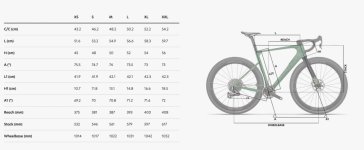
This is a good example of modern “progressive” (albeit gravel) geometry. This is the chart for the Wilier Rave SLR ID2.

Note the “large” size frame has a ~56 cm TT (56.6 cm to be exact). It also has a ~50 cm ST (and corresponding sloping TT) which is more typical of gravel/allroad frames to give them more stand-over clearance and additional saddle compliance via a longer SP extension.

Also, a standard upper 390’s reach but fairly low stack (for a gravel bike) of upper 570’s for an agressive racing geometry. Still, the HT angle is quite slack (compared to road geometry) at 71.2 degrees. Yet the ST angle is agressive at 73.5 degrees:

Wilier Rave SLR ID2
 

Attachments

  • IMG_1918.jpeg
    IMG_1918.jpeg
    40.8 KB · Views: 69

black lightning 1987

Moderator
Staff member
I just wanted to comment that stating that a 6’ person generally requires “at least” a 58 cm frame with a “60-62 cm” being more appropriate (if one runs a higher seat level) is rather misleading.

Back in the 80’s and 90’s that may have been true because road frames were more “equilateral” meaning many frames had a front triangle with level (horizontal) shorter top tubes and longer seat tubes.

This is certainly true of 2.8 Cannondales (C2.8) where a 60 cm size frame “only” has a 56 cm long TT. It’s for this reason that frame sizing based on typical seat tube (ST) lengths is rather misleading. A much better and more appropriate metric would be the TT as one has much more latitude to adjust seat height than one can vary stem length. The latter has a typical maximum variability of 6 cm (70-130 mm stems) whereas one can adjust a seat post by +/- 20 cm quite easily.

I’d further point out that, today, a 60-62 cm frame is generally intended for someone who is 6’3”+. A 6’ tall person does not need a frame that size regardless of one’s seat height. In fact, IMO it’s just dead weight one is lugging around with a frame that size when one can easily run a 25 cm seatpost (as I have on my gravel bike for added compliance) or a 15 cm seatpost (as I have on my C2.8 60 cm frame).

I don’t recall what the TT length is on the 58 cm 2.8’s but I’m fairly confident that one could run a longer stem (130-150 cm) with the saddle in the right position for one’s body type. IMO, these frames ride better with zero saddle setback or just a small amount (5-10 mm). Of course this means that one has to run a longer stem if one’s on a frame with a slightly shorter TT. Still, I’d venture the 58 C2.8 is no less than 54 cm along the TT (CC) requiring a 140 mm stem (for me). I’d consider this the lightest, comfortable stand over height, ideal frame size for a 6’ tall person. There may be some toe overlap issues with the stock Sub One fork but not substantially more than already exists on the 60 size frame.

In short, these frames are quite a bit higher (ST) but also shorter (TT) than most modern frame geometries so a current road bike frame in 58 cm would be too large IMO. All my bikes have ~56 cm TT lengths with the saddle setback and stem adjusted to give me a 58 cm length from saddle nose to handlebar (stem end center). Slightly different on flat bar bikes but not substantially so. Using this metric along with my standard 78 cm seat height (BB - saddle top) allows me to adjust many frames to suit my body. Shoes and pedals can change the seat height slightly but usually no more than +/- 1 cm.

So to summarize, I feel it may be misleading to inform the OP that a 58-62 cm frame is more appropriate for a 6’ person - generally speaking. It may be true for these C2.8’s (58-60 cm) but very few, if any, modern frame geometries would call for a frame as large as that.

I’d go further and say that the average bike frame size for a 6’ person back in the 70’s-90’s was a 58-60 cm but today that size would be a 55-57 cm with size 56 cm frames being the standard “large” (or ML) for many bike brands. I can make just about any 56 cm TT frame fit me regardless of dicipline.

To rank my 3 different bike geometries, all with ~56 cm TT’s, I have the following “sizes” (ST CT):

1) 48 cm Custom Gravel/30 cm SP/100 stem
2) 58 cm Pinarello/20 cm SP/130 stem
3) 63 cm Cannondale/15 cm SP/120 stem

The stem lengths depend of course also on the bar and shifter type & geometries but overall my goal is that 58 cm saddle to bar distance regardless of saddle to bar drop. Also, my SP lengths are from where they exit the frame to the top of the saddle. Most all my saddles add 5 cm to the actual SP extension. Also, I run 350 mm seatposts on all so the post insertion varies from 10 cm (the min) on the gravel bike to 25 cm on the C2.8. I could of course cut off 10 cm of SP on the C2.8 but I prefer keeping them at their standard 350 cm length so they can be used on different bikes and frames.

So, overall, I ride 78 cm height and 58 cm length.

They are all “fit” for me but of course due to their different overall designs and geometries, they ride rather differently. The Pinarello has the largest saddle to bar drop so it’s the most agressive. The C2.8 can only be “dropped” so far due to its very tall HT and geometry stack. So even with a slammed stem, the stack is higher than on the Pinarello. The gravel bike has the least saddle to bar drop, as expected, as well as the longest SP extension and is the most comfortable of the three allowing me to ride all day on it. The two road bikes are also rim brake whereas the gravel is disc brake which has an effect on my choice of ride in the city. It’s only when I’m on smooth tarmac that I’m happy with rim brakes now because rim calipers and carbon hoops are not the best of friends. They work fine in dry weather but they are noisy as heck. A well setup disc brake bike with good pads and rotors on the other hand is a different experience altogether. Much better suited for rough roads including bad tarmac which my town is famous for.

In short, a 54 cm frame may be a little hard to be made to fit a 6’ tall person but not impossible. Just ask the pros.

Last comment: BL1987 is definitely far more knowledgeable about Cannondales than I am so I defer to his wisdom 100% on this sub. However, I felt it was important not to mislead the OP where it comes to frame sizing in general.
Since this is a vintage site, my comments were based on common sizing circa 1990, when I bought my first road bike. A pro rider of my height at the time might have ridden a 56 cm frame to get the aerodynamic and miniscule weight benefits. But I think 58 cm would have been the average recommendation for a 6' tall recreational rider.
Since starting out on a 58 cm 1987 crit frame with a 56 cm top tube, I've been trending to larger frames. I have knee pain unless the seat height is quite a bit higher than "normal" for my height. I'm more likely to be comfortable on a frame with a 60 cm top tube than a 56. Taller head tubes on the larger frames reduce the saddle to bar drop, and compensate for the longer top tube length.
60+cm frames exist with top tubes considerably shorter than 60 cm. I have a steel Terry frame that's something like 59 x 55. I'm sure I have something in a larger size that has a similarly short top tube.
 

doxilia

Active Member
Thanks for clarifying that your comments were with respect to vintage 1980’s and early 1990’s frames.

Evidently body types affect very much what size frame is desireable for the same height person. My Cannon R900 in size 60 has a 56 cm top tube (CC) but it has a 58 cm seat tube (also CC) with a total length of about 63 cm (CT) leaving only 15 cm of the combined saddle and seatpost exposed. Of these, 5 cm are in the saddle so the exposed SP is only 10 cm. I find this to be the very upper limit of how short I want my SP to be. Because of this, I feel that a 58 cm frame would be more appropriate (for me) along with a 130-140 length stem. So in my case of a 6’ person, the C2.8 in size 60 is the very upper limit I’d want in this (or any) bike.

I can’t really see myself fitting well on anything that’s “XXL” (62 cm) in size. In fact, it wouldn’t even be about SP or stem lengths to fit the frame. I would simply find it unrideable as I couldn’t straddle the bike with my feet on the ground (the stand over height would simply be excessive for me.

I feel that traditionally, there was a tendency for bike shops to put riders on bikes that were too big for them because it made for higher stacks and customers felt more comfortable with an easier reach on the bike. However, there is no way to “grow” a fit on an oversized bike with adjustment to parts such as SP and stem. A slightly undersized or correct size frame allows for more adjustment via seatpost setback, saddle position, stem lengths and bar geometry.
 

black lightning 1987

Moderator
Staff member
As you mentioned, limb length and torso length can vary considerably in people of the same height.
I need to measure this custom Waterford, but I think the seat tube is at least 60 cm, and I have more seat post exposed than you. Also notice the tall head tube and that I still have more saddle to bar drop than a lot of folks run. The Austro-Daimler has similar dimensions. I'll try to remember to measure both.
full right.jpg
Austro Daimler 2 cr.jpg
 
Top