'Best' years for vintage Cannondale touring bikes?

echoplex

Well-Known Member
Ah, I hadn't noticed that the '97 T2000 was 8s... So going to 8 or 9 is just a matter of a new cassette (& shifter, of course)? The Acera freehub should accommodate?

I don't think there's any way to re-route/rearrange the shifter cables from the levers to make getting in and out of a handlebar bag workable- they're going to be in the way one way or another... I usually ride on the hoods, and with the (very) hilly local terrain I shift A LOT, which was why I've come to appreciate the brifters.... Are there Shimano-compatible alternative brands that route the shifter cables under the tape (and are 7, 8 or 9)? But really, it kind of looks like bar cons might be the simplest solution for now. And I see there are some NOS Dia-Compe levers like the T2000 had on eBay for cheap (though I don't know how ergo/comfortable they'll be....).

Again, thx for the wealth of info!
 

black lightning 1987

Moderator
Staff member
Best way to be sure about the hub would be to pull the cassette. If there's a 4.5 mm spacer behind the cassette, the hub should be 8/9/10 compatible.

Shimano Claris 8 speed STI is probably your best bet for shifters other than bar ends.

https://www.universalcycles.com/shopping/product_details.php?id=96277

For bar cons, I like Tektro or Cane Creek SCR-5 brake levers. The Cane Creeks seem to be out of production now. They are virtually the same shape as Campagnolo 9/10 era Ergo levers.

https://www.ebay.com/itm/164911973295?epid=2100098217&hash=item26658503af:g:GowAAOSwWZdhDko5

Shimano BR400 are pretty close to the same shape they made in the late 80s-1990s.

https://www.universalcycles.com/shopping/product_details.php?id=6373&category=669

If you end up going to 8 speed, I have a bunch of SRAM 8 speed cassettes, 11-30 I think.
 

echoplex

Well-Known Member
Of course I had to sign up on pace line now, too!

Hmm, interesting. I did find a photo of someone using 'noodles' to clear a handlebar bag.. I'm not sure I've got the clearance for either, but may be worth a try.. The Gevenelle levers/shifters are kind of interesting, though not cheap, and it's hard to tell if they'd really actually get the cables out of the way. But they'd keep the shifting where I've become accustomed to and use a simpler mechanism..

As for the cog/cassette...... Rats. No spacer. Does that mean if I want to go to 8 I need a new freehub body? Or a whole new hub (wheel..)? Or the Sheldon Brown 9s as 8...?
 

echoplex

Well-Known Member
Hmmm, now the v-brake noodle solution looks like the cheapest/easiest and might just give me the clearance I need... Makes more sense to try it before new levers, shifters, etc....
 

black lightning 1987

Moderator
Staff member
Did you take the cassette off? 8/9/10 freehub bodies measure about 1.41" (35.8 mm) from the ledge that the cassette seats on to the outside end.
 

echoplex

Well-Known Member
I had it off, now it's cleaned, lubed and back on! Maybe I'll take it off again tomorrow and measure to know for sure... But if I can get the v-brake noodle (ordered..) thing to work, I'll stick with the RSX levers and the 7 speed for now.
 

echoplex

Well-Known Member
Nineva br 2.jpg
 

echoplex

Well-Known Member
IMG_5230.jpg


The brake noodle solution to handlebar bag/STI cable clearance seems to have worked a treat, at least pedaling around the yard to test things out. Just enough clearance for the bag and keeps the cables out of the way of opening it. The 7sp system lives on...
 
Last edited:

JohnnyD

Well-Known Member
I never for the life of me would have thought to use v-brake noodles to do that. Glad to hear it worked out for you.
 

black lightning 1987

Moderator
Staff member
I never for the life of me would have thought to use v-brake noodles to do that. Glad to hear it worked out for you.

I wouldn't have either. Nor would have I thought it possible to bend the housing around and get it under the tape while remaining decent looking. It's great to be able to see what folks have tried without taking the time to do it on our own.
 

JohnnyD

Well-Known Member
I wouldn't have either. Nor would have I thought it possible to bend the housing around and get it under the tape while remaining decent looking. It's great to be able to see what folks have tried without taking the time to do it on our own.
You couldn't have said it better.
 

Swell

Member
Hello All, I hope this thread is still alive! I am new to cycle touring (and any sort of bike mechanics) and am asking for some advice. I ride a 1998 Cannondale F1000 that I purchased new. Not doing much mountain biking these days, so looking at shifting to cycle touring. Here is my dilemma - I'm looking at a 25" 1994 Cannondale T1000 in excellent condition and a comparable condition 'large' size 1991 ST600. My F1000 is a large size, but I find it a bit small at times. I am 6'1" with a 33 inch inseam, weigh 200 lbs, and have 35 inch arms. Both the bikes I am considering are at a very long distance from me as I live in a rural part of Canada - so I have not been able to see them yet, and will likely have to buy without first seeing it in person. I looked up the frame dimensions for the large '98 F1000, the large '91 ST600, and the 25" '94 T1000. Distance from ground to top tube is the most significant variant: 31" for the F1000, 32.5" for the for the ST600, and 34.47 for the T1000. I know that there are parts that can be changed to enhance the fit but don't know how much latitude that would give me. My feeling is the 25" T1000 would be the better bike to start with as far as fit is concerned. I am hoping to have some feedback and know this is a bit of a head-banger question - any help / advice would be greatly appreciated.
 

letsbike

Well-Known Member
I am pretty close to your size, a bit shorter, but with the same length legs. I ride a 25 inch frame 2001 T2000 with the CAAD3 frame that was introduced in the year 2000. My top tube standover height is 34.5 inches and the bike fits me fine with the seat post pulled up about 4 inches. I do like to tour with a bike that has the handlebars and seat level with each other, so consider that. I just replace my stem to fit for height and length. Tire size might also effect standover height. I run 700×32 tires.
When it comes to bicycle touring I would suggest that you buy a bicycle that you can get an adequate low gear out of. A low 20 inch gear is optional for pulling a 75 pound bicycle over a mountain pass with a smile on your face. My low is a 26 tooth chainring and a 34 tooth rear cog. On some older frames you can't make that happen. The other critical components are the power of your brakes, since your loaded bike will be heavy, and the strength of your wheels (which are also a braking components and friction induced heat sinks), so spoke count and sidewall wear are important for safety and getting you through areas where you will find no mechanical services available.
I love bicycle touring and I am looking forward to seeing what you decide on.
 

willmill

Member
We're twins! (Your measurements match mine.) And I agree with letsbike's comments.

I faced this dilemma when I bought my T1000 in late 1998. 26 years later, I'm glad I went with the 25".

But you could go either way (23" vs. 25"); the answer kinda depends on whether you prefer more "touring fit" vs. "race fit." For the self-supported touring I was doing, the 25" checked more boxes because: (a) The 1990s C'dale touring frames have shortish top-tubes for their size; the 25's 59cm effective top tube is right for me. The 23" frame (with a 1" shorter top tube) makes sense for a "race fit" with handlebars lower than the saddle.* (b) I wanted a comfortable upper body that was more upright, put less weight on hands, and put tops of the drop handlebars equal to the saddle height. (c) The 25" has a huge stand-over height, but as Grant Petersen at Rivendell writes, one rides a bike (doesn't 'stand' a bike). (d) The front-center distance is 1" longer on the 25" than the 23" frame (distance from bottom bracket to front axle is 1" longer), so toes don't clip fenders (there is zero toe overlap, which might not be the case on the 23"); wheelbase is longer and the bike more stable.

Here's how my 25" looks (more pictures in my Flickr album).

IMG_E7299.jpg


It's only showing about a handful of seat post with 175mm cranks. That's a 100mm reach stem.

*Speaking of "race fit," I recently saw a stunningly restored ST1000 in my neighborhood (here's a picture) with that setup.

Helpful?
 

Swell

Member
I am pretty close to your size, a bit shorter, but with the same length legs. I ride a 25 inch frame 2001 T2000 with the CAAD3 frame that was introduced in the year 2000. My top tube standover height is 34.5 inches and the bike fits me fine with the seat post pulled up about 4 inches. I do like to tour with a bike that has the handlebars and seat level with each other, so consider that. I just replace my stem to fit for height and length. Tire size might also effect standover height. I run 700×32 tires.
When it comes to bicycle touring I would suggest that you buy a bicycle that you can get an adequate low gear out of. A low 20 inch gear is optional for pulling a 75 pound bicycle over a mountain pass with a smile on your face. My low is a 26 tooth chainring and a 34 tooth rear cog. On some older frames you can't make that happen. The other critical components are the power of your brakes, since your loaded bike will be heavy, and the strength of your wheels (which are also a braking components and friction induced heat sinks), so spoke count and sidewall wear are important for safety and getting you through areas where you will find no mechanical services available.
I love bicycle touring and I am looking forward to seeing what you decide on.
We're twins! (Your measurements match mine.) And I agree with letsbike's comments.

I faced this dilemma when I bought my T1000 in late 1998. 26 years later, I'm glad I went with the 25".

But you could go either way (23" vs. 25"); the answer kinda depends on whether you prefer more "touring fit" vs. "race fit." For the self-supported touring I was doing, the 25" checked more boxes because: (a) The 1990s C'dale touring frames have shortish top-tubes for their size; the 25's 59cm effective top tube is right for me. The 23" frame (with a 1" shorter top tube) makes sense for a "race fit" with handlebars lower than the saddle.* (b) I wanted a comfortable upper body that was more upright, put less weight on hands, and put tops of the drop handlebars equal to the saddle height. (c) The 25" has a huge stand-over height, but as Grant Petersen at Rivendell writes, one rides a bike (doesn't 'stand' a bike). (d) The front-center distance is 1" longer on the 25" than the 23" frame (distance from bottom bracket to front axle is 1" longer), so toes don't clip fenders (there is zero toe overlap, which might not be the case on the 23"); wheelbase is longer and the bike more stable.

Here's how my 25" looks (more pictures in my Flickr album).

View attachment 14259

It's only showing about a handful of seat post with 175mm cranks. That's a 100mm reach stem.

*Speaking of "race fit," I recently saw a stunningly restored ST1000 in my neighborhood (here's a picture) with that setup.

Helpful?
I am pretty close to your size, a bit shorter, but with the same length legs. I ride a 25 inch frame 2001 T2000 with the CAAD3 frame that was introduced in the year 2000. My top tube standover height is 34.5 inches and the bike fits me fine with the seat post pulled up about 4 inches. I do like to tour with a bike that has the handlebars and seat level with each other, so consider that. I just replace my stem to fit for height and length. Tire size might also effect standover height. I run 700×32 tires.
When it comes to bicycle touring I would suggest that you buy a bicycle that you can get an adequate low gear out of. A low 20 inch gear is optional for pulling a 75 pound bicycle over a mountain pass with a smile on your face. My low is a 26 tooth chainring and a 34 tooth rear cog. On some older frames you can't make that happen. The other critical components are the power of your brakes, since your loaded bike will be heavy, and the strength of your wheels (which are also a braking components and friction induced heat sinks), so spoke count and sidewall wear are important for safety and getting you through areas where you will find no mechanical services available.
I love bicycle touring and I am looking forward to seeing what you decide on.
Letsbike, thank you for taking the time to share such helpful advice. I think the points you brought forward have saved me from making the mistake of buying the 23 inch framed ST600. I will compare the elements you have indicated - rims, spokes, and gears - and write a summary. Cheers!
 

Swell

Member
Willmill, Thanks for taking the time to share your expertise. I visited your Flickr page and am wowed by your bike and the adventures you have had on it. The restored T1000 is a beauty - I aspire to ride such a well-maintained bike. Particularly valuable to my process of discernment between the 23 and 25 is your explanation of the elements of 'race fit' versus 'touring fit' I like an upright riding position and will probably bastardize my bike with flat or butterfly bars in order to achieve it. I note your seat tube extension on your touring bike is at least 2 inches lower than mine is on my F1000. That makes sense given your explanation of fit. All the best, Cheers!
 

Swell

Member
I see the specs on the 1994 Cannondale T1000 are as follows:
"Rear Cogs Shimano Hyperglide 11-28 7 speed; and
Crank CODA 22, 32, 44 custom anodized rings"
Given the comments / observations of Letsbike and Willmill above,
How would you rate the gear ratios for getting a senior 200 lb rider and 75 lb bike and gear over a mountain pass,
and if these aren't optimal, than what changes would you suggest?
 

letsbike

Well-Known Member
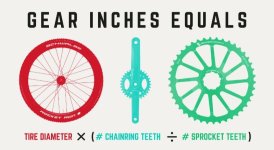
That set up of a 22T chainring and 28T large cog will give you a 21.2 gear inch low which should suit your needs. If you can find a cassette with a 30T rear cog that will get you down to 19.8 inches. Two things of note: The smaller a chainring is the faster it wears (although you just use it for steep climbs). Also 7 speed and 8 speed cassettes are disappearing. Any 7 speed cassettes on the mass market are intended for inexpensive recreational bicycles.
 

Attachments

  • Screenshot_20250702-195740_Chrome.jpg
    Screenshot_20250702-195740_Chrome.jpg
    75.3 KB · Views: 85
Top